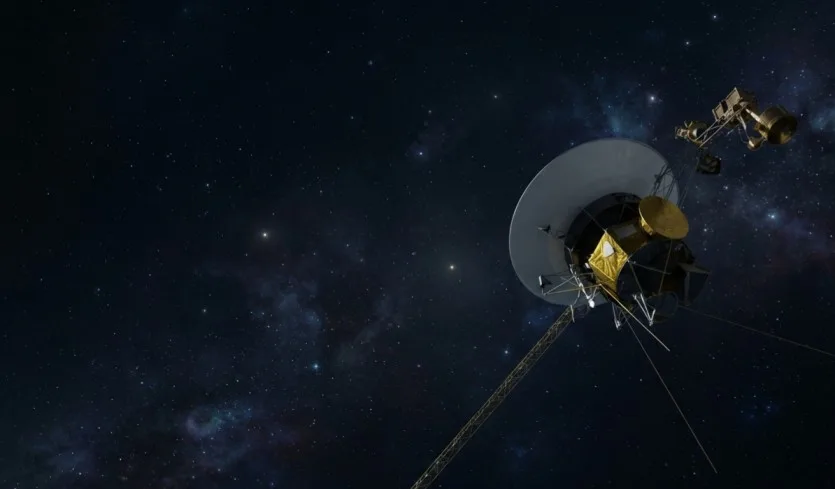
NASA's Voyager 1 spacecraft has reached a historic milestone by travelling one light-day away from Earth, becoming the first human-made object to reach this distance. Launched nearly 50 years ago, the spacecraft is now approximately 16.1 billion miles (25.9 billion kilometres) away from our planet.
The spacecraft reached the milestone on Wednesday, November 18, 2026, at 5:16 am Eastern Time. NASA received a signal confirming the achievement on Thursday, November 19.
The achievement highlights how far human space exploration has travelled since the spacecraft began its journey in 1977.
What Does One Light-Day From Earth Mean?
A light-day is the distance that light travels in 24 hours. Light moves at approximately 186,000 miles (299,000 kilometres) per second. At this speed, it can travel around 16.1 billion miles in one day.
Voyager 1 has travelled so far that a radio signal sent from Earth now takes approximately 24 hours to reach the spacecraft. Similarly, a signal sent back by Voyager 1 takes another 24 hours to reach Earth.
This means that communication between NASA and Voyager 1 now involves a delay of nearly 48 hours for a complete round trip.
The distance also shows the enormous scale of space and the challenges involved in operating a spacecraft so far from Earth.
NASA Faces a Data Transmission Problem With Voyager 1
While Voyager 1 achieved this historic milestone, NASA engineers are also dealing with a technical problem involving the spacecraft.
On November 14, the mission team discovered that Voyager 1 had stopped sending science and engineering data to Earth. NASA's Deep Space Network antenna in Canberra, Australia, was able to detect the spacecraft's carrier signal, but the expected data was missing.
The carrier signal indicates that the spacecraft's communication equipment and systems responsible for pointing its antenna towards Earth are still functioning.
However, engineers suspect that the problem could involve the onboard computer responsible for collecting information from the spacecraft's systems and preparing it for transmission.
NASA is investigating the issue to identify the cause and determine the next steps.
The distance between Earth and Voyager 1 makes troubleshooting difficult. Engineers must wait approximately one day for a command to reach the spacecraft and another day to receive its response.
NASA has also experienced a similar data transmission problem with Voyager 1 in 2023. The experience gained from resolving that issue is helping engineers investigate the current problem.
Voyager 1's Journey Began in 1977
NASA launched Voyager 1 on September 5, 1977, as part of a mission to explore the outer planets of our solar system.
During its journey, the spacecraft studied Jupiter and Saturn and sent back important images and scientific information about these planets and their moons.
One of its most famous contributions came in 1990, when it captured the iconic Pale Blue Dot image of Earth from a great distance.
In August 2012, Voyager 1 crossed the heliopause, the outer boundary of the Sun's protective bubble, and entered interstellar space.
It became the first spacecraft to reach this region, where it continues to travel beyond the influence of the solar wind.
Voyager 1 is moving away from Earth at approximately 38,000 miles (61,000 kilometres) per hour.
Why NASA Is Trying to Keep Voyager 1 Operating
Despite being nearly five decades old, Voyager 1 continues to represent one of the most important achievements in space exploration.
The spacecraft is powered by radioisotope thermoelectric generators, which produce electricity using heat from decaying plutonium.
However, its available power decreases over time. NASA engineers have gradually switched off some systems and scientific instruments to conserve energy and keep the remaining equipment operating.
The spacecraft's remaining instruments help scientists study the environment beyond the heliosphere, including magnetic fields, charged particles and plasma waves.
Voyager 1 and its twin spacecraft, Voyager 2, are the only human-made probes to have directly explored interstellar space.
Voyager 2 Could Reach One Light-Day in 2035
Voyager 1 is not the only spacecraft travelling through interstellar space. Its twin, Voyager 2, was launched on August 20, 1977, and followed a different route through the solar system.
Voyager 2 explored Jupiter, Saturn, Uranus and Neptune, becoming the first and only spacecraft to visit Uranus and Neptune up close.
It entered interstellar space in November 2018.
According to NASA's projections, Voyager 2 is expected to reach the one-light-day distance from Earth around November 2035.
Both spacecraft also carry Golden Records containing sounds, images and greetings from Earth. These records were designed to represent humanity and our planet to any potential extraterrestrial civilisation that might discover them in the distant future.
What Happens Next for NASA's Voyager 1?
NASA engineers will continue investigating the spacecraft's data transmission problem while working to keep its remaining systems operational.
Although the latest technical issue has interrupted the transmission of science and engineering data, the carrier signal confirms that Voyager 1's communication equipment is still functioning.
The achievement of travelling one light-day from Earth is another major milestone for a mission that has continued far beyond its original expectations.
As Voyager 1 moves deeper into interstellar space, the information it has already collected continues to help scientists understand the region beyond our solar system.